In rural Kakamega and neighbouring Siaya, the school day often begins with a jerry can. This field insight sets out the documented water-access challenge, what it means for girls and mothers, what Vision Giver Project is building in response, and how partners can help deliver it.
The problem
Across much of rural Western Kenya, household water is still collected from distant point sources: protected springs, shallow wells, boreholes and, in dryer seasons, sources that force families farther from home. Piped connections remain uneven, and reliability drops when rains fail.
County and research findings make the gap concrete:
- In Siaya County, the Siaya County Climate Change Action Plan reports that only about 58% of residents have access to improved water sources, while the rest rely on surface water. The plan notes long collection distances, with southern areas such as Rarieda and Bondo among the most water-scarce. Improved access here means access to an improved source category, not automatic equivalence to safe, reliable piped water at home.
- In Kakamega County, access to water services can look high on paper, yet many households still depend on wells, boreholes and protected springs rather than reliable piped supply close to home. Piped connectivity is stronger in urban and peri-urban areas and institutions than in many rural settlements.
- A Lurambi Sub-County, Kakamega study found that unreliable school water services are associated with pupils carrying water from home for handwashing, creating an avoidable burden on learners. See Zadock, Muasya and Gichuhi (Journal of Education).
- Research in western Kenya has linked longer household water collection time and children's involvement in fetching water with higher odds of recent school absence, with gendered patterns that place extra pressure on girls. See Dreibelbis et al., International Journal of Educational Development. Related work on reducing collection time and short-run effects on time use appears in recent rural Kenya research (2024).
These figures describe the regional context. They are not yet a substitute for Vision Giver's own village-level baseline. We are building community assessments so partner reporting can move from regional evidence to verified local numbers.
The human impact
Behind the percentages is a daily schedule that rarely appears in funding proposals.
Illustrative scenario informed by published research and community context
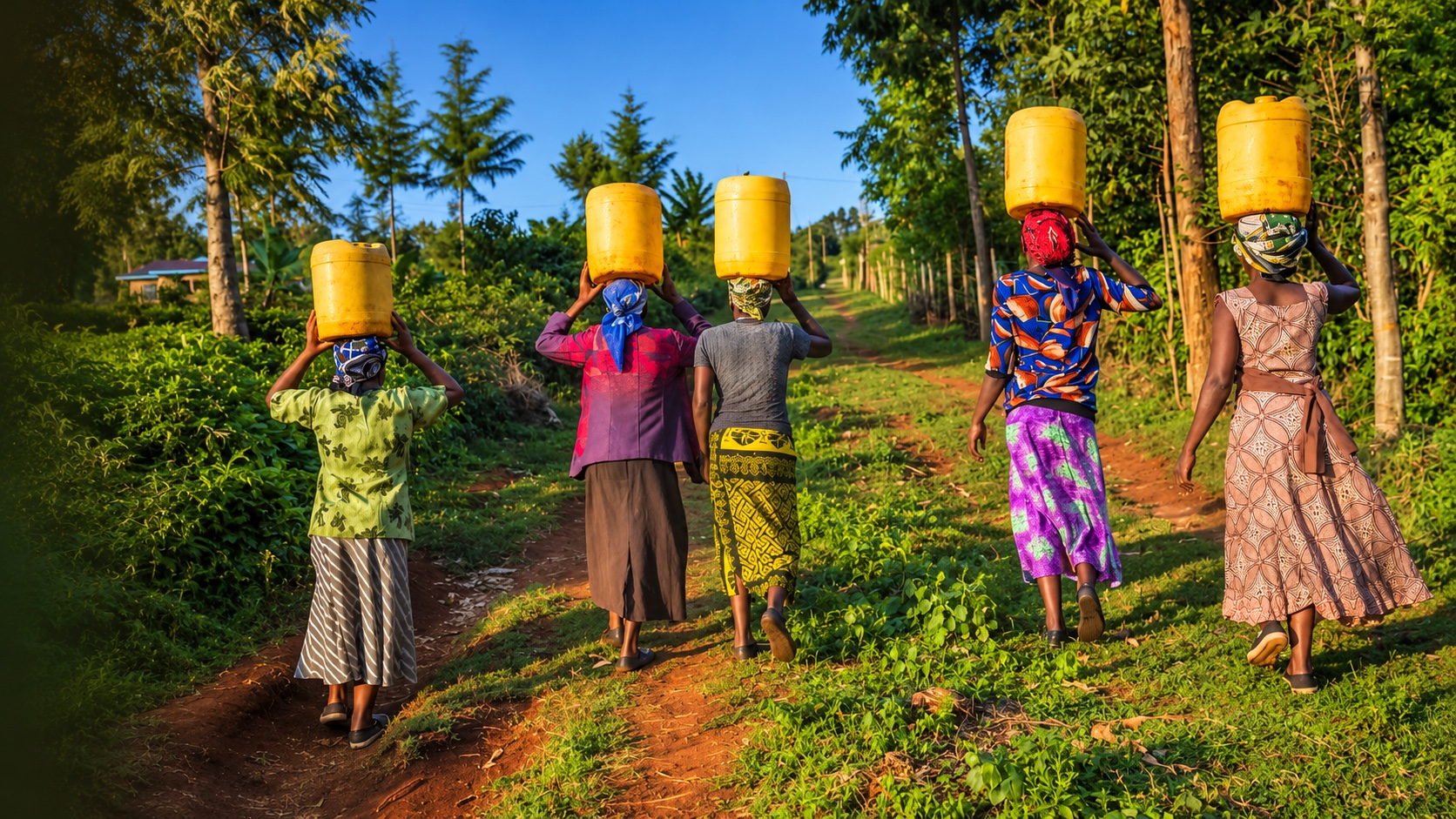
Before dawn, a girl of primary-school age leaves with a yellow jerry can. The nearest reliable source may be a long walk, longer still in the dry season. She returns with wet clothes, tired arms and little time to wash, eat or prepare for class.
Her mother faces a parallel choice: fetch water for cooking and washing, or open a small stall and earn the day's income. When both cannot be done, the girl often carries the water load and arrives after lessons have started, or stays home.
Repeated interruptions to schooling can affect learning continuity, confidence and educational progression. For some girls, these pressures compound other barriers to remaining in school. Water scarcity is not only a WASH issue. It is an education, health, livelihood and dignity issue at once.
This vignette is illustrative, not a named case study. Where families consent and safety allows, we will publish documented community stories with photographs from specific wards. Until then, we refuse to invent personal biographies.
Why this matters
- Education: girls spend more hours in class when the morning water walk shrinks.
- Health: safer sources and school water reduce illness that keeps children away from desks.
- Livelihoods: mothers reclaim time for farms, markets and savings groups.
- Dignity and safety: shorter collection routes reduce exposure on remote paths.
- Women's leadership: water committees give women decision-making power over a resource they already manage every day.
What Vision Giver is doing
Vision Giver Project is a community-based organisation in Kakamega County, Kenya, presented in our materials as a Public Benefit Organisation (PBO). Please review our organisational profile for mission, governance approach, program areas and contact details, and confirm registration particulars against the organisation's official certificate before contracting. Kenya's PBO framework is administered through the Public Benefit Organizations Regulatory Authority.
Our water work sits inside a wider women-and-children agenda: education support, livelihoods, child protection, agriculture and environmental stewardship. We do not treat water as a standalone hardware drop. Infrastructure is paired with women-led management and education support so gains last after construction ends.
| Intervention | Expected benefit | Status |
|---|---|---|
| Rainwater harvesting systems at households and schools | More reliable local water during rainy seasons; less morning travel | Needs funding |
| Community water points and source rehabilitation | Shorter collection distance; safer shared access | Needs funding |
| Women-led water committees and management training | Community ownership, maintenance and fair distribution | Program focus underway |
| School water and hygiene support | Better learning conditions; less need for pupils to carry water from home | Needs funding |
| Girls' education support linked to WASH communities | Improved attendance, retention and progression | Program focus underway |
Priority geography for this stream: rural and peri-urban communities in Kakamega (primary base) and Siaya, with expansion into neighbouring Western Kenya counties as partnerships allow.
The change we want to create
Donors should be able to see what a funded package is designed to achieve, and what is still a target rather than a completed result.
Design targets, not achievements. Figures below are near-term program design targets for a water-and-education partnership package in Kakamega and Siaya. Final numbers will follow community baselines, school enrolment lists, technical feasibility and partner agreements.
How we will measure progress
- Baseline and follow-up on walking time to the main household water source
- School attendance and late-arrival patterns for girls in participating schools
- Number of functioning water systems still in use after 6 and 12 months
- Active women water-committee membership and maintenance records
- Transparent partner reports separating money spent, activities completed and outcomes observed
First-phase funding opportunity
Interest without a clear investment frame is not enough for institutional partners. Below is the funding structure for the first phase. Exact KES totals are held in a budget pack for due diligence, not published as marketing numbers.
Indicative cost share
Provisional shares pending technical design, site selection and partner agreements.
- Water infrastructure~55%Rainwater harvesting, community points, school systems
- Women-led management~15%Committees, training, mobilisation and maintenance support
- Girls' education support~15%Linked support in WASH communities
- Monitoring and learning~10%Baselines, attendance tracking and partner reporting
- Coordination and accountability~5%Project management and financial controls
An opportunity to create lasting change
Every community deserves access to reliable water. Building infrastructure is only the beginning. We want systems that communities can manage, maintain and benefit from for years.
Proposed first-phase partnership targets (subject to baseline assessments, technical feasibility and funding agreements).
We are seeking partners who can help us:
- Finance the first phase of implementation.
- Provide water engineering and technical expertise.
- Support school WASH infrastructure.
- Strengthen women's community-led water management.
- Support independent monitoring and impact reporting.
An invitation to partners
Choose the pathway that matches how you want to work with us. Each link opens the contact form with that interest already selected.
Funding partners
Support water infrastructure, girls' education and community development costs for named communities in Kakamega and Siaya.
Discuss a funding packageImplementation partners
Deliver projects with us: technical design, community mobilisation, monitoring and joint field supervision.
Propose a joint delivery modelCorporate and institutional partners
Contribute expertise, materials, technology, employee giving or multi-year institutional partnerships.
Explore institutional partnershipAbout the organisation
Before committing funds, review who will steward the partnership.
- Organisational profile (mission, geography, programs, governance approach and contacts)
- Primary base: Kakamega County, with stated coverage across Western Kenya including Siaya
- Contact: Damaries Achieng Ochogo · [email protected] · WhatsApp +254 726 506 342
- Postal: P.O. Box 738 - 50100, Kakamega, Kenya
Selected sources
- Siaya County Climate Change Action Plan (County Government of Siaya / Maarifa). Supports the improved-water-access figure and scarcity notes for southern Siaya.
- Zadock, Muasya & Gichuhi. The Relationship Between Reliability of School Water Service and Pupils Carrying Water from Home to School for Hand Washing Practices. Journal of Education. Lurambi Sub-County, Kakamega.
- Dreibelbis et al. (2013). Water, sanitation, and primary school attendance: A multi-level assessment of determinants of household-reported absence in Kenya. International Journal of Educational Development.
- Short-Run Impacts of Reducing Water Collection Times (2024). Journal of the Association of Environmental and Resource Economists. Useful research context on time use and education effects.
Partner with Vision Giver Project to bring sustainable water solutions closer to communities and protect educational opportunities for girls in Kakamega and Siaya.